

Black-headed Bushmaster (Lachesis melanocephala) Case Study
Home > Biodiversity Nature & People > Conservation Philanthropy > Grants > MBZF Grant 13257065
Continent: North America
Country: Costa Rica
Grant Amount: $10,000
Awarded Date: November 04, 2013
Stephen Spear
The Orianne Society / IUCN Viper Specialist Group
100 Phoenix Road
Athens
Georgia
30605
United States
Tel: 17063537800
Mob: 12082415250
Developing survey methodology for the Black-headed Bushmaster

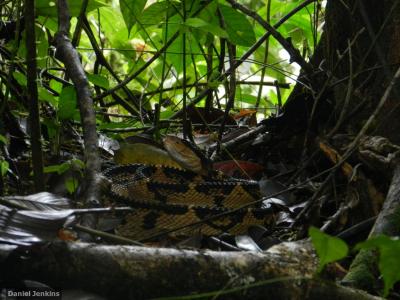
The Black-headed Bushmaster (Lachesis melanocephala) is one of the world's most elusive vipers and only occurs in a small part of Costa Rica. It depends on continuous forest and is likely declining. However, due to its secretive nature, no status assessments exist. The objective of our project is to test methods for locating bushmasters that can be used to help initiate conservation actions.
Bushmasters (genus Lachesis) are one of the most iconic snakes found in lowland tropical forests of Central and South America, with the Black-headed Bushmaster likely the rarest species of the group. The limited work that has been conducted on bushmaster species suggests these snakes are dependent on several specific resources and are thus particularly susceptible to disturbance. Their niche is characterized by an exclusively mammalian diet composed primarily of spiny rats and marsupials, an association with burrows of species such as agouti, paca, and armadillos, oviparous reproduction (unique among New World vipers), and an apparent association with primary rainforest. Conservation of bushmasters would likely enhance conservation of large burrowing mammals, rodents, marsupials, and all the plant species required to support the mammal species. Collectively, this represents a large and important component of tropical ecosystems. However, we currently understand very little about the details of bushmaster biology and the above generalizations need additional confirmatory data. The development of an appropriate bushmaster survey protocol is the first critical step towards effective bushmaster conservation and research. Meaningful conservation efforts for any species require research to assess population status as well as ecological studies to understand what the primary threats to the species are. The lack of a proven bushmaster survey protocol has prevented any direct conservation actions for this species. The paucity of information is due in large part to the cryptic nature of this species, as it likely occurs at low densities and spends much time underground.
We have the following objectives:
1) In concert with a local partner, Área de Conservación Osa, concurrently conduct visual encounter surveys and intensive burrow surveys across known localities for Lachesis melanocephala in Costa Rica;
2) Determine landscape and microhabitat associations with bushmaster presence;
3) Evaluate the efficacy of these methods for locating bushmasters to finalize a field protocol as well as identify focal study sites.
The text and images for this case study are uploaded by the grant recipient to raise awareness of the conservation work being done. Through its website the Fund provides the platform, but is not responsible for text or image content of case studies. We would like to sincerely thank the recipient for uploading a case study.

MBZF Grant 13257065 - located in Costa Rica, North America
Case Study Images
