

Freshwater sawfish (Pristis microdon) Case Study
Home > Biodiversity Nature & People > Conservation Philanthropy > Grants > MBZF Grant 11252587
Continent: Europe
Country: United Kingdom
Grant Amount: $10,000
Awarded Date: December 03, 2011
Nicholas K. Dulvy
IUCN SSC's Shark Specialist Group
Department of Biological Sciences, Simon Fraser University, 8888 University Drive
Burnaby
BC
V5A 1S6
Canada
Tel: 001-778-782-4124
Mob:
Development and publication of a global Sawfish conservation Strategy
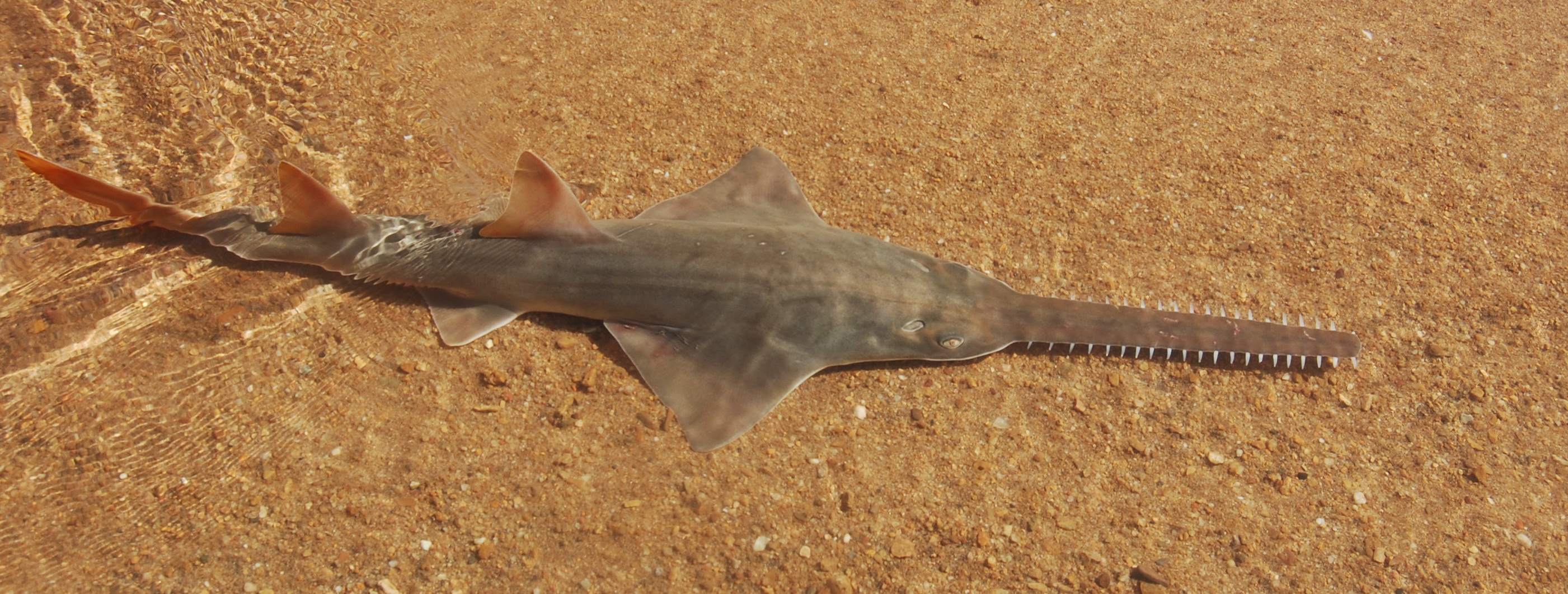
Sawfishes are arguably the most threatened marine fishes in the world. All seven species have experienced global declines of at least 90% due to fisheries overexploitation and habitat loss; consequently they're listed as Critically Endangered on the IUCN Red List. We will develop a Global Sawfish Conservation Strategy: clear, global-scale prioritized recommendations for meaningful research, education and conservation action to secure a future for sawfishes.
Sawfishes are arguably the most threatened family of marine fishes in the world. The global populations of all seven sawfish species have experienced historic declines greater than 90% due to fisheries overexploitation (directed and bycatch) and habitat loss, and are consequently listed on the IUCN Red List as Critically Endangered. There is a very real risk that these evolutionarily-unique species will be irretrievably lost without urgent conservation action.
Sawfishes were widespread in tropical and subtropical coastal waters worldwide, and often migrated through estuaries into freshwater systems. However, their distribution is now severely fragmented with sawfishes locally extinct from large parts of their former range.
All species of sawfish are very similar in their appearance, value and ecological function, though their preferred habitat varies among species (freshwater, estuarine to coastal marine environments). While there is some variation in habitat utilization, all species are faced with similar threats throughout their range. Therefore we are creating a global strategy that encompasses and focuses on all seven species to maximize the impact of our work.
Before conservation action and capacity building can begin for sawfishes, we first need to gather information of the basic detail of the problem throughout the vast range of these species. For example, there are less than 40 peer-reviewed published papers on the conservation, fisheries or ecology of sawfishes. Hence the development of any conservation strategy must first begin by scoping out and finding potential partners, suitable sites and opportunities for on-the-ground sawfish conservation, as well as collating all of the available information (scientific publications as well as anecdotal and cultural information) on this species.
The overall aim of this project is the development and publication of a GLOBAL SAWFISH CONSERVATION STRATEGY.
To do this we propose two main objectives:
1. Carry out a status review of all sawfish species globally through an online survey and a systematic review of all the literature on sawfishes.
2. Bring together 22 global sawfish experts at a workshop hosted by the Zoological Society of London with a view to undertaking the above-described scoping activity. This activity is an essential precursor to the subsequent development of more detailed plans for site-specific sawfish conservation programmes. Workshop participants will generate clear, global-scale prioritized recommendations for meaningful research, education and conservation action and a roadmap for the development of regional conservation programmes.
The information from these two objectives will culminate in the development of a widely-publicised IUCN Global Sawfish Conservation Strategy - detailing the current status (biology, threats, range states, local extinctions) of sawfishes. However, most importantly, this document will summarise the current key conservation activities, focal range states and collaborators who can assist in the implementation of these conservation activities. This document will be open-access and we will target our distributions to all interested parties and range states of sawfishes so that the document has the largest possible impact.
The conservation activities, focal range states and collaborators highlighted in the Global Sawfish Conservation Strategy will also allow us to determine where our regional efforts should be focused as phase two of this project.
We welcome input to our online Sawfish Survey from interested parties who have sawfish records - please follow this link or contact us for more information!
The text and images for this case study are uploaded by the grant recipient to raise awareness of the conservation work being done. Through its website the Fund provides the platform, but is not responsible for text or image content of case studies. We would like to sincerely thank the recipient for uploading a case study.
