

Sand Cat (Felis margarita) Case Study
Home > Biodiversity Nature & People > Conservation Philanthropy > Grants > MBZF Grant 150510401
Continent: Asia
Country: Kazakhstan
Grant Amount: $5,000
Awarded Date: June 11, 2015
Sand Cat current status in Kyzylkum Desert (Kazakhstan)
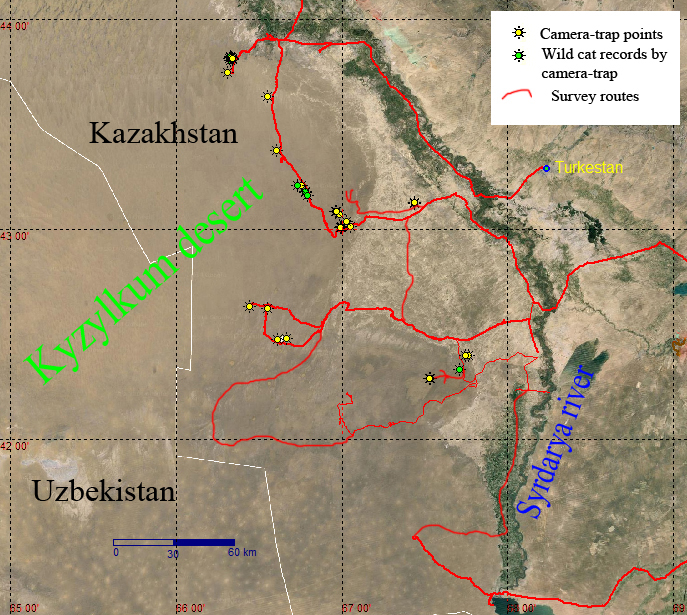
A survey in search of Turkestan Sand Cat (Felis margarita thinobia) was initiated in April 2015 in the eastern Kyzylkum Desert, Kazakhstan. The study area consists mainly of sand dunes with sparse scrub vegetation. Camera-trapping and censusing small animals were the main methods of investigation. Although we did not record Sand Cat, we think that large tracts of habitat are suitable for the species.
We made seven field visits and spent altogether 42 days in the Kyzylkum Desert between April 2015 and June 2016. We traveled about 1,000 km by jeep and walked more than 100 km in 16 transects that were 1–12 km long. During nocturnal hikes we observed only a few mammals. We deployed camera-traps at 28 locations with a total sampling effort of 1,372 camera-trap days. On average we left the camera-traps for 49 days at each location until the batteries were empty. Our sampling effort yielded 3,648 photographs and videos showing 12 mammal species, 9 bird species and 5 reptile species. Asian Wildcat was recorded at 14 sites but we did not obtain any record of Sand Cat.
During transect walks and camera-trapping surveys we recorded a large number of rodents, birds and reptiles including:
· Tolai Hare, Great Gerbil, Midday Gerbil Meriones meridianus, Libyan Jird M. libycus, Mole Lemming Ellobius talpinus, Five-toed Jerboa Allactaga elater, Three-toed Jerboa Dipus sagitta, Ground Squirrel Spermophilopsis leptodactylus, 25 species in total.
· Black-bellied Sandgrouse Pterocles orientalis, Pander's Ground Jay Podoces panderi, Great Grey Shrike Lanius excubitor, Crested lark Galerida cristata, Turkestan Tit Parus bokharensis, Isabelline Wheatear Oenanthe isabellina, Desert Wheatear Oenanthe deserti, Finsch’s Wheatear Oenanthe Finschii and Red-headed Bunting Emberiza bruniceps, more than 80 species in total.
· Wonder Gecko Teratoscincus scincus, Gray Gecko Gymnodactylus russowi, Steppe Agama Trapelus sanguinolenta, Toadhead Agama Phrynocephalus interscapularis, Desert Monitor Varanus griseus, Striped Racerunner Eremias lineolata, Steppe Runner Eremias arguta, Reticulate Racerunner Eremias grammica, Sand Boa Eryx tataricus, Whip Snake Hemorrhois ravergieri, Ribbon Snake Psammophis lineolatus, 15 lizard and four snake species in total (Shakula and Baskakova 2014).
Colonies of Great Gerbil were observed everywhere and regularly, with 6 to 20 animals per colony. Reptiles were active from March to late October. Spotlighting surveys proved to be useful for assessing the number of Wonder Gecko, whose eyes shine bright orange in the light.
Grant document
The text and images for this case study are uploaded by the grant recipient to raise awareness of the conservation work being done. Through its website the Fund provides the platform, but is not responsible for text or image content of case studies. We would like to sincerely thank the recipient for uploading a case study.
